
Wylde Blogs
CBD Roll-On vs CBD Balm UK 2026: Cost Per mg, Onset, Discreetness and COA Transparency Compared
Walk into any UK CBD shelf in 2026 and you will notice something: the boundary between roll-ons and balms is quietly dissolving. Hybrid formats are arriving — Incr-EDIBLES' 400mg CBD Roll-On Balm, marketed for tired and aching muscles, is a neat example of the two categories converging in one package. So which format actually suits your routine, and which one gives you more for your money?
Below we compare them honestly: how each feels and absorbs, what you pay per milligram, how quickly you might notice anything at all, how discreet each is in daily life, and — most importantly — which one is more likely to come with a certificate of analysis you can actually read.
Texture first: the format is the function
These products are not simply different packaging for the same substance. Their textures are chosen for a purpose. Balms are thicker and "stay put"; creams spread easily and absorb faster; roll-ons are described as clean, portable and easy for quick reapplication. That difference in base — oils, butters, waxes versus lighter emollients — shapes where and when you use each one.
A useful guide from The London Dispensary puts it plainly: a balm is richer and more occlusive, with more oils, butters or waxes; a salve is softer, with more oil and less wax; and a roll-on is the most convenient option for targeted application. If you want something that sits on a specific area and stays there while you move, a balm is the natural fit. If you want to apply without touching the product or your skin, a roll-on wins.
Side-by-side: roll-on vs balm
| Feature | CBD Roll-On | CBD Balm |
|---|---|---|
| Texture | Light liquid or gel, glides via a metal or plastic ball | Rich, occlusive, wax-and-butter base |
| Application | Hands-free, targeted, easy to reapply | Fingertip massage, warms and melts on skin |
| Feel | Cooling, clean, fast-drying | Cushioned, lingering, slightly tacky at first |
| Discreetness | Very high — looks like a deodorant or lip balm | High at home, lower in public (needs hands) |
| Best for | Desks, gym bags, travel, daytime top-ups | Evening wind-down, massage, larger areas |
Cost per mg: where the maths gets interesting
Price per bottle tells you very little. Price per milligram of CBD tells you almost everything.
A benchmark worth keeping in mind: a 750mg CBD roll-on priced at $44.99 works out at roughly $0.03 per mg of CBD, with a price-per-ounce figure of about $33. That is a competitive rate — and it shows how a higher upfront price can still represent good value if the concentration is genuinely there.
For a broader picture, Forbes Health's 2026 price-per-millilitre comparison is instructive: Lazarus Naturals at $0.37/ml ($28 for 75ml), Soul Rapid Relief at $0.40/ml ($40 for 100ml), Carmen's Medicinals at $0.77/ml ($46 for 60ml), Cornbread Hemp at $0.79/ml ($54.99 for 70ml), Batch CBD at $0.92/ml ($55 for 60ml), Extract Labs at $1.20/ml ($89.99 for 75ml) and Aspen Green at $1.50/ml ($89.99 for 60ml).
Note that per millilitre and per milligram are different measurements — and a cheaper millilitre is not automatically a cheaper milligram. Our own CBD Living Freeze 300mg roll-on and its higher-strength siblings are worth comparing on mg, not volume: the CBD Living Freeze 750mg Body and CBD Living Freeze 1500mg Body sit in the same format at different concentrations, while the CBD Living Freeze 4500mg Body is the high-strength option for people who use a lot, often.
Balms tend to be compared differently — by tin weight and how far a pea-sized amount stretches. A rich balm often goes further per application than people expect, which can narrow the cost gap considerably.
Onset: what to realistically expect
Topical products are not a fast-acting route in the way that, say, a sublingual oil is often described. Many people find roll-ons feel cooling and immediate in sensation — particularly menthol-forward formulas — while the deeper, more gradual effect builds over twenty to forty minutes.
Balms, being more occlusive, keep the formula in contact with the skin for longer. Some users report a slower build but a more sustained, warming feel, which suits evening use or post-exercise routines. If you want something you can reapply mid-afternoon without washing your hands afterwards, the roll-on has the practical edge.
Discreetness: a genuine differentiator
This is where roll-ons quietly win. A slim roll-on in a bag pocket is unremarkable — no residue on fingers, no scent cloud, no need for a mirror. Balms ask for a little more: warm it between fingers, massage it in, wipe your hands. At home that is a pleasure. On a train, less so.
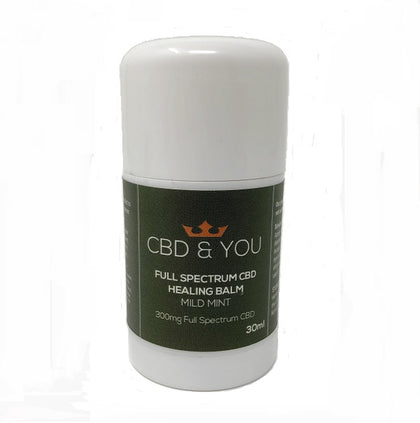
If you are looking for a balm that earns its place in a slower routine, our Full Spectrum CBD Healing Balm is formulated as a rich, stay-put base for targeted massage — the opposite end of the spectrum to a quick roll-on swipe.
COA transparency: the deciding factor
Forbes Health's 2026 scoring weights lab testing at 40%, price at 30%, ingredient quality at 15% and COA provision at 15% — disqualifying any product that fails for contaminants or inaccurate labelling. That weighting is a useful mirror for your own buying decisions.
Why it matters: a CBD Oracle test of a $59.99 / 1.3 oz roll-on (also around $0.03 per mg) found 68.5 mg CBD per gram of lotion versus 63.4 mg for a rival product — a reminder that label claims and reality can drift.
A good certificate of analysis shows detail, not just a pass. One lab-tested product documented 19.6mg CBD and 0.533mg THC per millilitre, with pesticides, mycotoxins and heavy metals all recorded as "not detected". That is the level of granularity UK buyers should expect — cannabinoid content per unit, contaminant screening, and a batch number that matches your actual packaging.
Roll-ons are not inherently more or less transparent than balms. What matters is whether the brand publishes a current COA per batch, and whether the numbers on it align with the label. Ask before you buy; a brand that hesitates is telling you something.
Which should you choose?
Choose a roll-on if: you want hands-free, targeted application; you reapply during the day; you value discretion and portability; or you want a cooling sensation you can feel straight away.
Choose a balm if: you prefer a slower, ritual-led routine; you want something occlusive that stays in place during massage; you are treating larger areas; or you use it mainly at home in the evening.
And in 2026, the hybrid is a legitimate third answer. Roll-on balms promise the glide of one and the richness of the other — worth trying if you have been undecided.
The bottom line
Neither format is better; they are built for different moments. Compare cost per milligram rather than per bottle, expect topicals to be gradual rather than dramatic, weigh discreetness honestly against your day, and treat a readable, batch-matched COA as non-negotiable. Get those four things right and the roll-on-versus-balm question answers itself.